Reviews From 2008
- Skywatchers 08: A Sky-guide Calendar, by Ben Shadick
- Cochrane, The Real Master and Commander, by David Cordingly
- Cruising with Bettie, by Bob Steadman and Kay Nottbusch
- Eileen Quinn Songbook for Voice and Guitar
- Guy Harvey's Underwater Realm
- Guy Harvey's Underwater Realm: Sharks
- Guy Harvey's Underwater Realm: Pacific Sailfish
- Guy Harvey's Underwater Realm: Striped Marlin
- Mighty Merry Too, by Mary McCollum
- Cruising Catamaran Communiqué, by Charles E. Kanter, AMS
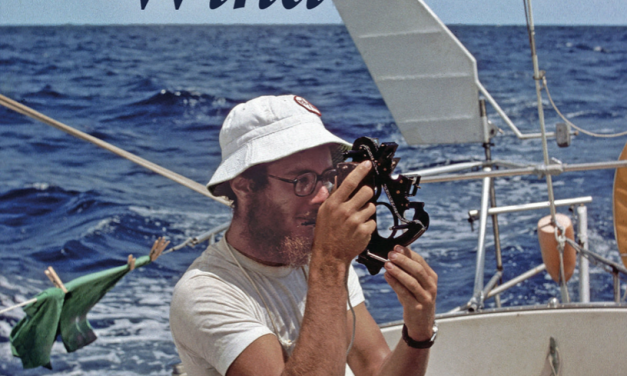
- On the Wind: The Marine Photographs of Norman Fortier, with introductions by Calvin Siegal and Llewellyn Howland III
- Sailing Grace, by John Otterbacher
- Storm and Conquest, by Stephen Taylor
- The Best Used Boat Notebook, by John Kretschmer
- Celestial Navigation in the GPS Age, by John Karl
- Spirit Sail — A Memoir of Spirituality and Sailing, by Nelson Price
- Education of a Falcon, by Mike Riley
- Small Boats Big Adventures, The Small Craft Advisor Interviews, by Craig Wagner
- High Seas Schooner — Voyage of the Harvery Gamage
- About! A Waterway Adventure, by Gillian Outerbridge
Skywatchers 08: A Sky-guide Calendar
by Ben Shadick (Heritage House, 2007; 28 pages; $16.95 Canada, $12.95 U.S.)
Review by Karen Larson, Minneapolis, Minn.
The night sky is full of starry friends. The trouble is that most city folk (even the sailors among us) are unfamiliar with these regular visitors. For those, like me, who would like to get to know the night stars - as well as for the advanced stargazers among us - the Skywatchers 08 calendar is a treasure. You could hang this calendar on the wall, I suppose, but it's going to be much more useful to me as a training tool on the boat...out there where the sky is black and the stars are the brightest.
Author Stan Shadick teaches astronomy courses at the University of Saskatchewan and tells the recreational stargazers among us: "I hope to share with the reader some of the excitement of recent astronomical discoveries, along with the charm of ancient tales and First Nations legends about the constellations." How does he propose to do this? Flip to any page of this calendar and you'll understand instantly.
Each calendar page has a notation on every day of the month, with such useful information as this one selected randomly for January 23: "The ancient Greek and Roman mythmakers imagined that Cetus constellation depicted a whale. The great beast was sent by Neptune to ravish the coast of Ethiopia after Queen Cassiopeia bragged that she was more beautiful than Neptune's nymphs." The following day features a more technical blurb: "About 4 hours after sunset, look for Saturn rising above the eastern horizon. The ringed planet will be just 3 degrees to the left of the waning gibbous Moon, as shown on the map below."
With the help of a small map in the lower corner, you should be able to find Saturn, as promised. And with the full-sized image of the Chicago night skyline, you should be able to recognize the stars in the January night sky. Flip through the calendar pages and the skylines change from Toronto to London to Vancouver to Baltimore and so on.
This isn't just a 12-page full-color calendar for the wall. The publishers thoughtfully added pages so Ben Shadick could give us additional background, trivia, resources for stargazers, full-sky maps by season, and planetary conjunctions of interest (Saturn and Mars will be very close together on July 10, for example).
If you're in Canada, Europe, or the northern half of the United States (anywhere between the 37th and 60th parallels), this calendar will be extremely useful every month of the year. Don't be dismayed that we received this gem late in the year and its review doesn't appear until the February newsletter. For those who are in the northern part of the northern hemisphere, it's been a bit chilly for stargazing anyway. Spring is on the way. Now's the time to get the calendar.
Back To TopCochrane, The Real Master and Commander
by David Cordingly
(Bloomsbury USA, 2007; 362 pages; $32.50)
Review by Patty Facius, Minneapolis, Minn.
It's no news to serious readers of Patrick O'Brian's Jack Aubrey series that their hero's character is based on the real life naval career and exploits of the late 18th and early 19th century British frigate commander, Thomas Cochrane. What may surprise those readers, however, is the extent of the similarities between the historical figure and the fictional character: a captain loved and respected by his crews; a captain well-known for his brilliant tactics and seamanship; a close friend who serves as his ship's surgeon; a man whose life seems almost charmed at sea but prone to controversy and ill-fated efforts on land, culminating in a ruinous stock market scandal. Sound familiar, JA readers?
Other authors, including C.S. Forester for his Horatio Hornblower series, have also drawn on Cochrane's naval experiences. But author David Cordingly's purpose for writing this book is not to pay homage to Cochrane's literary legacy. Instead, Cordingly concentrates on his subject's historical legacy that, according to the author, has not been fully recognized or appreciated by British naval historians.
The author tells the story of an ambitious man who was born into Scottish nobility and entered the British navy relatively late in life (at age 17) because the family fortune had been squandered by his father. If the young Lord Cochrane were to become a wealthy man, he would need to find a way to make his own fortune. At the same time, war with France was imminent. And serving in the British navy in time of war offered excellent prospects for quick promotion and prize money. But Cochrane turns out to be more than a resourceful and zealous Napoleonic-war era British naval captain. He is a man motivated by money, yet highly principled, and driven to fight for his honor, reputation, and place in history.
Cochrane was born a bit ahead of his time and suffered for it. He was elected to the British Parliament, where he fought for social reform and made many political enemies who considered him and his political allies as radicals and firebrands for revolution. Cochrane also made enemies of his superiors in the Admiralty by using his seat in Parliament to publicly criticize and condemn the navy's traditions of flogging, press gangs, and overall poor treatment of its sailors. Not until years after he had left Parliament was Britain and its navy ready to enact the social and naval reforms he championed.
Cordingly assists the reader with an excellent glossary of 18th century naval terminology. Maps, battle diagrams and a cutaway line drawing with named parts of a 38-gun frigate (one of Cochrane's commands) are also great aids to the reader. The book includes beautiful color plate portraits and paintings of the period, all relevant to Cochrane's life at sea and on land. This book is well-researched and dense with background, not only about his subject but also about the political, social and naval life in 18th and 19th century Britain. Cordingly's sources include the Cochrane family archives, transcripts of courts-martial, civil court lawsuits, ships' logs and Cochrane's controversial autobiography, The Autobiography of a Seaman.
This book certainly stands on its own as an excellent biography for historians or readers who are interested in naval history. If you fall into the latter category, and are also a Jack Aubrey fan, you will enjoy the best of both worlds.
Back To TopCruising with Bettie
by Bob Steadman and Kay Nottbusch, DVD and slide show
(produced by Bob Steadman, 2007; 51 minutes; $19.95 - available from http://www.TheSailingChannel.com)
Review by Karen Larson, Minneapolis, Minn.
Good Old Boat writer, Bob Steadman, and his partner, Kay Nottbusch, want to share their cruising adventures with the rest of us...those sailors who are dreaming, but not yet experiencing, the cruising lifestyle. Since leaving Los Angeles three years ago, they've cruised with a video camera or two, taken delight in experiencing new cultures and activities, and made good use of Bob's experience as a professional cinematographer. This 54-minute DVD, supplemented with a visually rich slideshow, is a real treat for armchair sailors.
In 10,000 miles, Bob and Kay take us to the offshore islands of the Baja; to the mangroves of Bahia Tenecatita; to the Gulf of Tuantepec and beyond to El Salvador. They go hi-lining in Costa Rica, and dine in a restaurant full of monkeys and a tiki bar that is a swimming pool. They dive in Costa Rica, transit the Panama Canal, explore the Caribbean coast of Panama, and visit the San Blas Islands. They motor up jungle rivers and explore the Third World from a floating home.
By capturing just the highlights of 10,000 miles in 51 minutes, this professionally produced DVD takes the viewer on a fast-paced tour of the places visited and written about by many cruisers. But now the sights and sounds are available in a richer and moving medium. The final cruising destination on this DVD is the Bahamas.
The photographer in me is always aware of the trouble anyone must go to in order to capture images from several points of view. As is the case in any good film, Bob makes it look simple, but the tuned-in viewer will be aware that filming your own experience takes planning and execution, both before and during the experience. For some, trying to enjoy the moment while actually working to record it for the enjoyment of others may very well take away some of the joy of the experience. Bob has indeed sacrificed so that others of us may sail, dive, and beachcomb with the crew of Bettie. He may enjoy operating in this dual mode, but I don't envy him.
The cruise of Bettie continues and the camera is never far away from Bob's capable hands. Watch for more DVDs in the future by this dynamic duo. There's a whole world out there waiting to be explored and photographed, edited, and shared with the rest of us. In addition, stay tuned for more articles from Bob Steadman in Good Old Boat.
Back To TopEileen Quinn Songbook for Voice and Guitar
(CD Baby, 2007; $49.95)
Review by Steve Christensen, St. Paul, Minn.
Jimmy Buffett may be the songwriter that most people associate with living in the islands, but ask any Caribbean sailor about cruising music and the name you're likely to hear is Eileen Quinn. Eileen has been cruising full time since 1994, when she and her husband, David, left Toronto in their 1987 Bayfield 36, Little Gidding. Along the way she developed a style of music she calls "bluewater," dealing with some of the lesser-known aspects of the cruising lifestyle, such as how to anchor your boat without the intervention of a marriage counselor. From Quinn's The Anchoring Dance:
The perfect little parking place is easy to find
All you really gotta do is read his mind
If what your honey wants is hard to tell
When the hand signals fail, you can always YELL
Grind your teeth, shout till you're hoarse
There's always one more step, you can file for divorce
No better way to tell a true romance
Than to do, do, do, do, do, do the anchoring dance
She now has five CDs in her catalog, with songs that range from upbeat ditties about heaving over the rail to poignant songs about the dream of building a boat (for previews go to http://cdbaby.com/group/quinntessentials). Her newest project is the Eileen Quinn Songbook for Voice and Guitar. This is a CD ROM that contains the lyrics, melody music, guitar chords, chord charts, and tablature in printable form for all of her 61 songs. For 34 of the songs there is even a sound file with backup music for you to play along with and practice your chops.
Many of these songs would be great fun to learn for your next sing-along on the beach. My personal favorite is called "Trouble in Paradise" about relationships afloat. About the tune, Eileen notes,"I write songs to cope with stuff...and it seemed like a better idea to write this country lament about everything that was bugging me about my loved one instead of picking a fight."
The songbook comes as a searchable PowerPoint presentation that requires Windows 98 Second Edition or later (so, for now, Mac users are out of luck). With this songbook and a bit of practice (and just a bit of talent) you will be the hit of any nautical sing-along.
Back To TopGuy Harvey’s Underwater Realm
(Bennett Marine Videos)
Review by Amy Murphy, with Nora (4), Audrey (6), Emma (8), and Mike (older than 8)
Marine biologist and artist Guy Harvey travels the world’s oceans to study and film pelagic species. These journeys are documented in the DVD series, Guy Harvey’s Underwater Realm.
Guy Harvey’s Underwater Realm: Sharks
(24 minutes; VHS, $24.95; DVD, $29.95)
Sharks have existed on Earth for 400 million years. In the past few decades, their numbers have been greatly reduced, and their continued existence as a species is desperately threatened. Graphic video footage illustrates the exploitation and mistreatment of sharks for use as food or in alternative medicines. This effectively drives home the gravity of the situation, but the more sensitive viewers in our family found it distressing.
Far more enjoyable were the wonderful underwater sequences filmed at the “Shark Rodeo Dives” in Walkers Cay, Bahamas. Close encounters with reef and black tip sharks were exciting and informative. This title was packed with information, and most appreciated by the adults.
Guy Harvey’s Underwater Realm: Pacific Sailfish
(17 minutes; VHS, $24.95; DVD, $29.95)
Some of the best waters for finding pacific sailfish are off the shores of Guatemala. Although this species is quite popular among sport fisherman, little is known about their feeding and group behaviors.
Dr. Harvey’s team of researchers visits the waters of Guatemala to observe the fish from beneath the surface. Breathtaking underwater videography, combined with compelling narration, made this a favorite for the whole family.
The 6-year-old viewer particularly enjoyed seeing sea-turtles and other fish under a floating tree. The conservation message was refreshingly positive.
Guy Harvey’s Underwater Realm: Striped Marlin
(23 minutes;VHS, $24.95; DVD, $29.95)
Dr. Harvey travels to the Baja peninsula with a group of scientists and artists to view the striped marlin up close. Video footage of striped marlin circling baitballs and interacting with other predators was as fascinating as we had come to expect. The adults found the informational content somewhat sparse, but the youngest viewers requested several encore viewings.
Back To TopMighty Merry Too
by Mary McCollum
(Merry Publishing, La Crosse, Wisconsin, 2007; 199 pages; $15.95)
Review by Susan Lynn Kingsbury,
Moreno Valley, Calif.
Author Mary McCollum lived the dream. She retired from her teaching career, sold her home and belongings and moved onboard her boat. And she sailed. Unlike many navigators who map out their route in great detail in advance, Mary took her time, letting weather, seasons, and simple intuition dictate the course she took as she sailed solo aboard Mighty Merry Too across the Pacific Ocean.
Mary’s conversational style of storytelling quickly draws the reader in — as if she is telling her story face to face, or allowing one to read her diary. One can certainly imagine sitting down for a beer or cup of coffee with this navigator/grandmother, while in animated conversation she shares her adventurous tale. When asked where she got her confidence to embark on such an endeavor solo, more than likely she’d quote her father: “Anybody can do anything once they set their mind to it.” Mary believes these words to be true, as is evident in her steadfastness and ability to continue on, even when she meets with obstacles and unpleasant circumstances along the way.
Researching and finding her perfect boat for solo cruising, a 24-foot Dana, she orders one and waits. Finally taking delivery of the vessel in Seattle, Washington, she sails Canadian waters and explores the San Juan Islands. She decides to sail from San Francisco to Mexico, then to South America (Ecuador), the Cook Islands, New Zealand and numerous points in-between and beyond. Along the way, Mary treats readers to descriptions of the sights and the people of the regions, tells us about the fellow sailors she meets, and relates lessons she learns along the way.
Unlike other navigation books that begin with the embarking on a planned cruise, Mary starts off by revealing a lot of back story in order to explain why “a little gray-haired grandmother” would have the desire to sail solo across the Pacific in the first place. Readers are given a detailed account of her parents’ immigrant beginnings and lives; a history of her childhood; sailing beginnings; her own marriage, divorce, career and family life, and, ultimately, an explanation of how she made the decision to make sailing her life.
Some readers might find themselves wondering when the author is going to get to the sailing part of her story. Although family members and friends who know Mary may appreciate all that led up to her journey, the majority of those who regularly read sailing accounts could do with a much more condensed version.
Those who do read on will find a pleasantly surprising ending, which led me to wonder if a sequel to Mighty Merry Too might be in the works . . .
Back To TopCruising Catamaran Communiqué
by Charles E. Kanter, AMS
(SAILco Press, 2007; 407 pages; $29.95)
Review by Wayne Gagnon
Antigo, Wisc.
According to the back cover of Cruising Catamaran Communiqué, Charles E. Kanter has been a marine surveyor for over 36 years, and has been a liveaboard-cruiser for 15 of those years. So to say that he is qualified to write a comprehensive book on multi-hulled sailboats would be an understatement. In addition to his hands-on experiences, he co-authored Sailor’s Multihull Guide in the 1990s, wrote Cruising On More Than One Hull in 1992, and Cruising In Catamarans in 2002. As I was reading, there was no doubt in my mind that the man knows what he’s talking about. However, the title may be a bit deceiving as the book contains useful information on trimarans as well as catamarans.
Very early in the book, Kanter gives a fairly good treatise on cruising and much of the information is pretty generic and can be applied to mono- as well as multi-hulled vessels. He then goes on to extol the virtues of multi-hulled boats over mono-hulls, citing such obvious things as their shoal draft and stable ride. He also gives a lot of useful information on docking, hauling out, anchoring, the advantages of two engines over one, trampolines, and many other details on the characteristics of these boats. The back of the book contains some tips on having a survey done, a glossary of terms that he uses throughout the text, and a bibliography of other informative sources. All three of these sections contain information that, again, could be applied to all boats, regardless of the power source or number of hulls. In addition to all of this information, he reviews over 60 different multi-hulls, most of which are accompanied with line drawings and/or photographs.
There are some mechanical problems (spelling, grammar, etc.) that could have been avoided with more careful editing, but unless you’re an English teacher like me, these probably won’t bother you much. The layout also seems a bit awkward to me. For example, the section on anchoring would fit better with the rest of the technical information. Instead, it’s after the boat reviews, which makes it seem a bit out of place. Given these minor concerns, Cruising Catamaran Communiqué will be a valuable asset to anyone thinking about purchasing a boat for cruising, or anyone who would simply like more information on multi-hulled sailboats.
Back To TopOn the Wind: The Marine Photographs of Norman Fortier
with introductions by Calvin Siegal and Llewellyn
Howland III
(David R. Godine; 2008; 160 pages; $40)
Review by Michael Maxfield,
Gatesville, Texas
Norman Fortier, born in 1922, was still a youngster when he became interested in photography. Drafted into the military during World War II, he became an aerial photographer and honed his photography skills during the war before returning to New Bedford, Massachusetts, where he took on normal photography jobs. He gradually migrated to marine photography, and in 1947 opened his own studio at the Concordia boatyard. The rest, as they say, is history.
On the Wind: The Marine Photographs of Norman Fortier, is a 9 x 10-inch coffee-table book with more than 140 black and white images depicting aspects of the Southern New England marine environment: mostly sailboats, but also motorboats, working trawlers, a couple of lighthouses, boatbuilders, and sailors, stunning ground level and aerial shots of bays and harbors, and even a few heartbreaking images of wrecked sailboats.
Anyone interested in marine photography, the Buzzards Bay area, or fine photography will find something to enjoy in these photos. This collection of images was culled from more than 100,000 negatives obtained by the New Bedford Whaling Museum. It is easy to see why Norman Fortier was in such demand as a marine photographer.
His work portrays a historical view of the New England coastal areas in which he lived and worked during the mid- 20th century. He attended and photographed hundreds of races and regattas in the area, and very few yachts passed through Buzzards Bay without being captured by Norman’s cameras.
The introductions by Calvin Siegal and Llewellyn Howland III discuss the history of marine photography in the Buzzards Bay area, give insight into Norman’s equipment and style, and provide a brief glimpse of the man and his life. The 127 pages of photos are divided into nine chapters selected by topic or region, such as Concordias, New York Yacht Club Cruises, The Islands, Cuttyhunk, and New Bedford.
Some of the photos I found to be most memorable included the four-masted Russian bark, Kruzenshtern, aerial photos of Padanaram and other harbors, children swimming on horseback off Naushon (a shot reminiscent of my own childhood experiences), and a heartbreaking shot of the 38-foot yawl, Seachief II, hard on the rocks.
This book displays some of the best in New England marine photography and would make a cherished addition to any sailor’s library.
Back To TopSailing Grace
by John Otterbacher
(Samadhi Press, 2007, 254 pages, $19.98)
Review by George Zimmerman
Olympia, Wash.
Extended worldwide ocean cruising is a dream of many sailors. Yet a very small percentage of sailors ever turn their dreams into reality. Lack of money, busy jobs, limited time, the inability to adequately prepare for such a venture, concerns over safety and other obstacles, real and/or self-imposed, get in the way. The dream just fades away.
Meet John Otterbacher, a Michigan clinical psychologist, state representative, later a senator, sailor, and owner of Grace — a 50-foot Bill Tripp-designed cutter-rigged ocean cruiser. John, his wife Barbara, and their three children return from a 16-month cruise on the Great Lakes with the burning desire to go “out-there” again, “ . . . only for a longer time.” Two years into the planning and preparation phase of their cruise, John is working out on a Stairmaster when he experiences the pressure on an elephant stepping on the center of his chest. A rush trip to the hospital, angioplasty, and a diagnosis of severe coronary heart disease changes John’s live forever.
Sailing Grace is the story of a courageous man, with either an unbelievably strong will or incredible stubborn streak, and a love of sailing. Eighteen months before they are scheduled to leave on their ocean cruise, John and his wife confront his life-altering illness head-on. The first half of his book is an open, brutally honest discussion of how a formerly healthy man faces a life-threatening illness, and what his illness means to him, his wife and children. The surprise in this book is when John and his wife, decide to continue with their plans and take the entire family cruising on the world’s oceans.
This is a well-written book and a pleasure to read. The author has an engaging style of writing that enables the reader to identify with the very real crisis occurring in his life. The actual sailing that is undertaken in the book only happens in the second half and is somewhat limited. This is not a book about sailing; it is about the dream of world cruising, and keeping that dream alive. After finishing the book, the reader can follow the sailing adventures of John and his family through their website at http://www.sailing-grace.com. Having recently encountered my own life-altering illness, this book was an inspiration to me.
Back To TopStorm and Conquest
by Stephen Taylor
(W.W. Norton & Company, Inc. 2008; 280 pages; $26.95)
Review by John Danicic,
Minneapolis, Minn.
As a solid fan of the “Age of Fighting Sail” stories of Patrick O’Brian, CS Forester, Alexander Kent and Julian Stockwin, I have read the names Pellew, Corbet, the Nereide, Indiamen, and the (horrible) Leopard quite often. They are mentioned by these authors in their marvelous sea stories to give historical landmarks and outline to what are mainly fiction writings based on real events in the late 18th and early 19th centuries.
Author Stephen Taylor brings this historical account of a series of events in 1809 to life with a compelling, well-written book that describes what a succession of huge Indian Ocean storms did to the British East India Company’s convoy of ships known as Indiamen, and recounts a sea battle against the French in the same ocean for the strategic Mauritius Islands, then known as the Ile de France. Thus, the “Storm and Conquest” of the title. Both the French and the British principals are explored in a carefully written and arranged tale. Using excerpts from actual letters, logs and diaries, Taylor weaves a footnoted account that provides an accessible and readable history in a style that puts the reader on the deck through the eyes of those who were there, as well as supplying the underlying explanations of who, what and where. There are sobering descriptions of life aboard on what could be a 6-month trip from India to England, for even the well off “cabin” travelers will make that cramped airline coach ticket look like a feather bed.
There are also major insights to the names I listed above, including a fascinating description and explanation of Captain Robert Corbet, known as competent and zealous to his superiors but brutal to his crew. Using excerpts from the trials, journals and letters, Taylor brings out the official view but does not ignore the forecastle hands and, using their own words, lets the crew describe how they feel about Corbet. This quote, taken from one of the mutiny court-martial trials that Corbet survived: “If he would leave off beating them with the great sticks and take the knots out of the Cats they would go anywhere with him. If not they wished [for] another commander.” Patrick O’Brian relates to us his fictionalized version of Captain Corbet and the battle of the Mauritius Islands in the fourth book of his Aubrey/Maturin series, “The Mauritius Command.”
All in all, Storm and Conquest is a satisfying, entertaining read for both the dedicated non-fiction enthusiast and those fiction devotees interested in the historical background that underlie the stories of those great “fighting sail” writers.
Back To TopThe Best Used Boat Notebook
by John Kretschmer
(Sheridan House, 2007; 240 pages, $29.95)
Review by Karen Larson,
Minneapolis, Minn.
Six years ago, John Kretschmer and Sheridan House came out with a compilation of 40 used-boat reviews that John had written for Sailing magazine. That book, Used Boat Notebook, was (and continues to be) a valuable resource for good old boaters.
Now a sequel, The Best Used Boat Notebook, has made its debut. The names and covers look very much alike and are likely to be confused.
Don’t let yourself be confused. John has made a second significant contribution to the bookshelves of those good old boaters who are shopping for their next sailboat, by offering reviews of 40 more great and affordable boats.
Each book (both can be purchased from the Good Old Boat Bookshelf) comes with reviews of 10 additional world cruisers, for a total of 50 boats in each book. John also includes appendix items of interest: dimensions and ratios (he explains the significance of those formulas and ratios, such as sail area-to-displacement) and a glossary of terms. The newer book even comes with John’s ode to good old boats: an article written about the value and worth of good old used boats.
A minor rant: the boats covered in John’s books are getting larger as time goes on, and the reader has to wonder why he included 10 new boats suitable for world cruising in his used boat book when there are many older candidates just as suitable?
As I noted when I reviewed the first of this pair of books in 2002, http://www.goodoldboat.com/newsletter/octnewslett26.html#book, there is no sense in reviewing a book of reviews. Instead, I recommended the book highly and listed the boats that were included. I continue to recommend the newer book. Here’s the list of boats covered this time:
19- to 30-footers
West Wight Potter 19, Santana 22, Com-Pac 23, Nimble Kodiak 26, Grampian 26, Pearson 26, Bristol 27, Catalina 27,
Nor’Sea 27, Newport 28, Catalina 28, J/29, Alberg 30, Dufour Arpege 30
32- to 36-footers
Contessa 32, Freedom 32, Jeanneau Attalia 32, Islander 32 Mk II, Caliber 33, Pacific Seacraft 34, Sabre 34, Hallberg-Rassy 34, Tartan 34, C&C 35, CS 36 Traditional, Morris Justine 36, PDQ 36
37- to 52-footers
Express 37, Lagoon 37, Pacific Seacraft 37, O’Day 37, Prout Snowgoose 37, Cabo Rico 38, Privilege 39, Cal 39, Passport 40, Pearson 40, Venezia 42, Beneteau First 456, Irwin 52
10 great new boats to sail around the world
Tartan 3400, Southerly 110, Hanse 400, J/133, Hunter 45CC, Catalina Morgan 440, Island Packet 440, Cabo Rico 42, Lagoon 500, Beneteau 523
Celestial Navigation in the GPS Age
by John Karl
(Paradise Cay Publications, 2007; 280 pages; $24.95)
Review by Durkee Richards,
Sequim, Wash.
John Karl provides the cleanest and most elegant introduction to the fundamental concepts of celestial navigation that I have read. I would even recommend this book to those who have a curiosity about how it all works but never intend to actually practice this ancient art.
He begins with a few essential fundamentals — a spherical earth with a surface organized via lines of longitude and latitude, celestial objects with known positions relative to a rotating earth, and an observer with a means to measure the apparent altitude of these celestial objects. These equal-altitude lines of position would really be circles if “drawn” on a globe.
John then develops the concept of the “navigation triangle” and introduces the Nautical Almanac, which will provide some of the key parameters of the navigation triangle. Next, it’s on to the math required to do a direct computation solution using a handheld calculator. And finally, he shows how the results can be plotted as lines of position on a chart of appropriate scale. John does compare and contrast direct computation versus sight reductions with tables (H.O. 229 and H.O. 249).
John includes a chapter on “Special Sights” with topics such as Polaris; meridian sights, including determining both latitude and longitude from meridian sights; finding time from a lunar line of position and a star fix. Then, John calmly takes the student to the holy grail of historical celestial navigation — lunar distances.
Only then, after he has helped his students put aside their angst about sight reductions, does John introduce the sextant and teach its use. The final chapter includes over 70 examples “for understanding and confidence.” Each includes useful comments to aid the learning process.
I recommend this book, without hesitation, to anyone with an interest in celestial navigation.
Back To TopSpirit Sail — A Memoir of Spirituality and Sailing
by Nelson Price
(iUniverse, 2008; 114 pages; $14.95)
Review by Bob Wood,
Angola, N.Y.
Spirit Sail is about a special sailor’s vision, of seeing fundamental truths in much of what happens during his time afloat. The book’s premise is that, despite the contrast between the action-filled world of the sailor and the more sedate world ashore, they both have the same underlying values. Nelson Price explores these values in many of the sailing moments we take for granted.
His chapters on hospitality, friends, romance, and a variety of other subjects are the softer, subtler issues of sailing. Deeper significance as well as increased enjoyment are found in these aspects of boating life. The author has decades of experience in both faith-based programming and sailing that uniquely position him to write about this intersection of disciplines.
It is not an easy book to breeze through, by virtue of the subject matter. A sailor’s beliefs are quite often as fiercely defended as his or her lifestyle. Both are intensely personal matters. Overcoming this resistance takes a combination of willingness on the reader’s part and compelling precision on the writer’s.
If you are looking for a volume on sailing expertise or hardware, please look further. If, however, you hope to glimpse God’s awe on the water or the cause and effect of our relationships, there is insight here.
This light-hearted book is a readable joy-filled memoir finding meanings for us to consider, to ponder, and accept or reject as we may choose. Perhaps best of all, by the very exercise of choosing, each of us will have moved a bit more toward self-discovery.
For those who are open to examining the essence of our recreation, or perhaps have already sensed a link between the diversion of sailing and regeneration of spirit, consider the book Spirit Sail. Sailing, like life, can be enriched by discovering the currents beneath the surface.
The author seems a man without pretension — a passionate sailor sharing his great love of the world. I was left with the feeling that I’d like to spend an afternoon with him, to exchange theories, explore common ground. You might also.
Back To TopEducation of a Falcon
by Mike Riley
(Published by the author; e-book and audiobook available for downloading at http://education.of.a.falcon.googlepages.com, 2007; 180 pages; $5 to $25 depending on format)
Review by Karen Larson,
Minneapolis, Minn.
Mike Riley, his wife Karen, and their son, Falcon, stepped outside the mold and cruised the world. Mike has published several books while based anywhere and everywhere in the wild blue yonder. Two of these books are about their adventures as a cruising family: The Tigers will Eat You Alive and, more recently, Education of a Falcon.
Education of a Falcon tells of Mike’s single life aboard his Columbia 24, Tola; meeting Karen in Papua New Guinea, where she had been working as a teacher; and the courtship and marriage that followed. He tells of their continued cruise as a couple, and the conception and birth of a son. Falcon is his name, and the way that came about is an interesting chapter in itself. For more, you’ll have to read (or listen to) the book. In addition, the choice of where to deliver a baby while cruising in the Mediterranean is an interesting tale, emphasizing the can-do attitude of many cruisers.
Although this book was written from Mike’s point of view, it is beautifully narrated in its audio form by Karen, whose storyteller skills as a teacher are evident. This role reversal makes perfect sense to the listener. While the book and audiobook chronicle the family’s life set against a cruising backdrop, they are not written as a log and they do not necessarily follow strict chronology. That is no problem for the reader or listener, who will realize that Mike makes occasional ventures backward and forward in time to bring organized thoughts together.
Reading or hearing a book like this makes it possible for parents with young children or those with babies on the way to comprehend what cruising with children is like. Mike does not sugarcoat the tale. He presents their experiences from his own perspective. He does have strong opinions about the quality of the cruising life they lead and, as a result, he preaches on occasion. It is a healthy and wholesome life and those who have not made similar choices will be envious. Those who may yet follow in the wake of the Rileys will be encouraged to do so as a result of reading the book.
The Riley family continued cruising on the Columbia 24 as a threesome but eventually they switched to a Dickenson 41 ketch, Beau Soleil. Mike ends the tale with a look at Falcon as a young man headed for college. The combination of home-schooling, public schooling, and the eclectic cruising lifestyle has enriched him in ways that put him far beyond other age-mates. It will be interesting to see how he adapts to the structured collegiate world and the choices he will make going forward from there.
I, for one, have the highest of hopes for Falcon and all kids who have seen the world from the unique perspective of a small boat run by a loving cruising family.
Back To TopSmall Boats Big Adventures, The Small Craft Advisor Interviews
by Craig Wagner and Joshua Colvin
(Small Craft Advisor, 2007; 167 pages; $19.95)
Review by John R. Butler,
Rogers, Arkansas
The Small Craft Advisor magazine has been called the “successor to The Small Boat Journal.” Editors Craig Wagner and Joshua Colvin, “minimalist” outdoor adventurers, missed reading a magazine devoted to real sailors with really trailerable sailboats and launched their answer over 8 years ago. One of their regular features has been interviews with fearless adventurers and respected designers.
Regular readers of The Small Craft Advisor will read and remember each of these interviews with renewed interest. Newcomers will discover a reading pleasure they feared had ebbed with the tides of publication.
Craig and Joshua know small craft. They ask the right questions to satisfy our individual interests in sometimes heroes. Even if you consider some adventurers to be masochistic madmen, they may answer the very questions you pondered when you first heard of their escapades, or just about their future plans. The editors wisely let the subjects control the length of the interviews. Some were short and sweet, others long and detailed. Some will leave you thinking, “That’s about the way I did it” — or “I would have, if only &helipp;”
Sven Yrvind, the psychopathic Swede, had such startling innovations and adventures that the editors introduced him with the following: “Few, if any, have taught us more about truly small boats offshore.” Among his ideas were a rudder with twice the lateral area of the centerboard and covering the inside of the hull with carbon fiber for greater strength.
The temptation is strong, when you scan the contents, to go directly to the interview about your good old boat, whether it was your past love or current source of adventure. I found both going directly to page 64. The interview with Jerry Montgomery shed new light on the Montgomery 15 sloop I owned in the ’80s and am sailing again.
Do you dog-ear some pages, then underline or highlight especially interesting items? You’ll find many, like you really don’t need GPS, a windvane, or autopilot to sail around the world in a small boat.
I did wish that they had headers on every page giving the interviewee’s name — good for short memories! I also wished for more dates: issue or month, as well as the given year of the interview. Specific dates, when possible, of some of the adventures would answer “What was I sailing, and where, when he was out sailing there?”
This is not a “couldn’t put it down until I finished it” kind of book, but a fine one to pick up and read at every spare moment, to carry along for an appointment.
Better yet, immerse in it, late in the eve when the TV has gone adrift. Your ensuing dreams will love it. Or perhaps you will just be left wondering: has Kristofer “Harley” Harlson started on his non-stop circumnavigation in the 8-foot Sea Biscuit he was building when interviewed back in 2006?
Back To TopHigh Seas Schooner — Voyage of the Harvey Gamage
(DVD produced by SEA-TV Productions http://www.sea-tvproductions.com; 95 minutes; $29.95)
Review by Bob Wood,
Angola, N.Y.
High Seas Schooner chronicles a three-week voyage from the Virgin Islands to Gloucester. With veteran crew and student navigators, the schooner Harvey Gamage brings maritime history to life. It is education with an edge.
Each passing day shows novices and seasoned crew developing confidence in each other. In the occasional brief interviews, the crew is eager to share their thoughts. However, the journal is not a travelogue of idyllic, fun-filled days. It portrays a classic wind-driven craft on a working voyage, with an emphasis on working.
Some of the most memorable scenes on this DVD are filled with muscle-straining teamwork. There are realistic conditions of pitching wet decks, and commands drowned out by flogging canvas. The infrequent moments of relaxation help balance hours of serious effort.
This superb work should become a classic. As documentary journalism, it is exceptional. As art, its composition, camera work, music, and voice-over blend naturally into a captivating tale. Narration by veteran sailor David Berson is concise and delivered well.
A special mention on the camera work. The Harvey Gamage’s sea-motion in heavy seas is so realistic that your stomach will feel the heavy schooner’s deck rise and drop as it beats to weather.
The music editing was also spot-on. Upbeat, enlivening at introduction and evocative at journey’s end, the score was understated and polished.
Two minor points: the audio was faint in two spots due to deteriorating weather, and a bit more narration would have explained sail handling as the boat plunged into wind and waves. Both are understandable considering the dramatic conditions. Those same points strengthen the breathtaking realism and urgency of the crew’s response to a storm. Anticipation builds with miles logged, from the schooner slipping through the quiet beauty of the Caribbean to the cold whistling wind and slamming gear in the northern Atlantic.
High Seas Schooner is an honest glimpse at traditional passagemaking — the interplay between man and inexorable elements. An emotional and physical work of wild beauty and bold sailors, the video speaks loudly to all who celebrate kinship to the sea.
Concluding the journey in a quiet harbor with Berson’s reflections, the epic left me spellbound and thoughtful, wanting more. I would not have missed it for the world.
In this world of “two-thumbs-up” superlatives, a fitting tribute is difficult. Perhaps two thumbs and a smile … all turned up.
Back To TopAbout! A Waterway Adventure
by Gillian Outerbridge
(Nautical Publishing Company, 2007; $21.95)
Review by Carolyn Corbett,
Lake Shore, Minn.
Lin and Larry Pardey describe Gillian Outerbridge’s photo-packed chronicle of her journey from New York through the waterways of the northeastern United States and southeastern Canada as a heartwarming, well-written story that illustrates “simple but elegant truths: alone does not equal lonely, and adventure comes in all sizes.” If Lin and Larry like it, it must be OK.
Actually, it’s considerably better than OK. It’s darned good. Gillian Outerbridge did something few single grandmothers do. She set off on a 20-foot sloop to bring to life a dream she’d harbored for some 40 years. From her launching at Liberty Landing Marina, right across from Ground Zero in New York, Gillian describes her journey in an easy-to-read manner peppered with droll humor. Of Tucker, her canine companion and avid hunter, she says, “I had to accept that I was living with a serial killer.” Her whirlwind search for the Flicka she named Dart was “marine speed-dating,” while the waves she encountered along the way were “short, steep and peevish.”
Together, over a period of two summers, Gillian, Tucker, and Dart explored thousands of miles of lakes and locks, breakwaters and bridges, marinas and “Merci Madames.” Inland canals, Scottish dancing, hot-air balloon regattas — the days were filled with serenity and serendipity as Dart’s crew of two embraced each new opportunity. Perhaps the most wonderful part of the story is the joy this mature matron found in the cruising lifestyle and her fellow explorers. In a letter to her mother, the author wrote, “I am so happy, I live with a grin.” Quite a change of course for a woman whose catalyst to take to the water was a traumatic ordeal at her home back in Bermuda, where she’d struggled with an intruder holding a knife to her throat.
The somewhat nervous woman who held the helm at the beginning of the journey morphed into confident skipper as she traversed the Erie Canal, the Trent-Severn, Georgian Bay, and the Thousand Islands. She squeaked under bridges, progressed through lock after lock after lock, and weathered a passing hurricane.
With refreshing honesty, the author candidly describes her trepidation at the outset, the “conflagration of charred bridges” she left in her wake, and other assorted struggles. “I discovered,” she says, “that when an unexpected challenge arose, I was far too busy dealing with the circumstances to be afraid. I faced all the fears and concerns, the apprehension and qualms, and dealt with them. I just plowed on through them and emerged on the other side, stronger, braver, and ultimately proficient in survival skills.”
Back To Top